Driving Instructor Car Finance: The Automatic Generation
Manual is disappearing from Britain's roads. Here's what the automatic shift means for driving school fleets, and how driving instructor car finance is adapting.
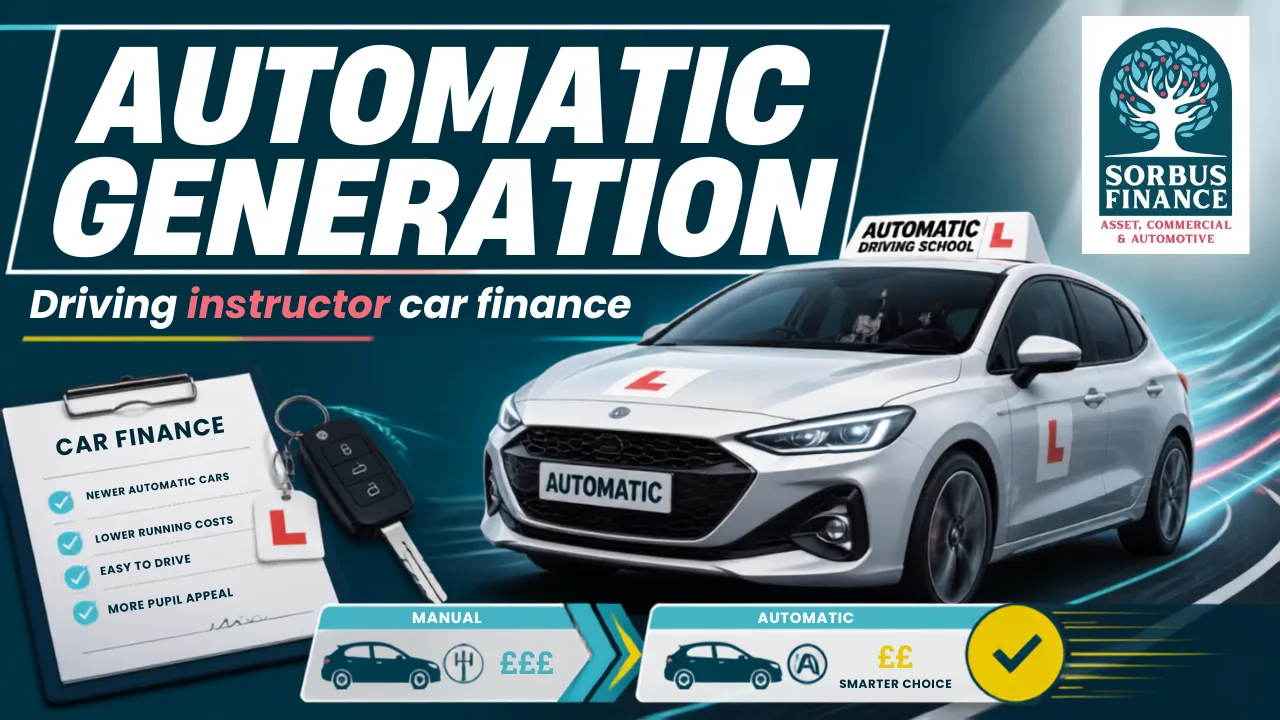
The Automatic Generation: What Happens When Nobody Learns to Drive Stick
In short: Manual transmission is disappearing from the UK new car market, down to roughly a third of petrol and diesel registrations and falling further each year. That shift is pushing up costs for driving schools, from pricier automatic dual-control vehicles to higher insurance, at a time when the instructor workforce isn't growing to match demand. Schools that plan the transition with structured driving instructor car finance are managing it far better than those reacting car-by-car.
A generation of British drivers is growing up without ever touching a clutch pedal. For driving schools, that's not an abstract cultural shift, it's a fleet, insurance, and financing problem landing on their desk right now.
The numbers tell the story plainly. Manual share of new UK car registrations has fallen from 55% in 2019 to 34% in 2025, among petrol and diesel models, with manuals now standing at just 13.7% of the wider new car market this year, according to industry registration data reported by Fleet News. Car manufacturers are quietly retiring the manual option model by model, not because demand vanished overnight, but because the EV transition makes automatic transmission close to unavoidable. Electric motors don't need gears in the way a combustion engine does.
Driving instructors are watching this play out from the front seat. Every pupil who wants to learn in the car type they'll actually own after passing is nudging demand toward automatic. Every driving school weighing up its next fleet purchase is asking the same question: keep investing in manual, or start moving the fleet over, and how do you pay for it without a shock to cash flow?
Why Is Manual Transmission Disappearing in the UK?
Manual gearboxes are being phased out largely because of the shift to electric and hybrid vehicles, which are automatic by default, combined with manufacturers scaling back manual variants as demand narrows. Even among buyers who still actively choose between manual and automatic petrol or diesel cars, manual share has more than halved since 2019. With the phase-out of new petrol and diesel car sales approaching later this decade, that decline is set to continue rather than level off.
What This Means for Driving Test Pass Rates
The share of UK practical tests taken in automatic cars has been climbing steadily for several years, tracking the same direction as new car sales. What's less discussed is the pass rate gap sitting underneath that shift: automatic-only test pass rates have historically run a few points below the combined national average, even though automatic is marketed as the easier route, removing clutch control and gear selection from the cognitive load of the test. It may simply reflect a smaller, more varied pool of candidates and instructors still building automatic-specific teaching expertise. Either way, it's a detail worth factoring into pupil expectations and course pricing rather than ignoring.
Why Automatic Costs More for Driving Schools
For an instructor, moving from manual to automatic isn't just a car swap. Automatic lessons typically run several pounds more per hour than manual, reflecting the higher capital cost of automatic dual-control vehicles and the smaller pool of instructors offering them, which keeps demand, and prices, elevated.
On the insurance side, the gap is measurable and significant. Compare the Market's own data shows that 51% of its customers could get a comprehensive quote of £742 for an automatic car, against £596 for a manual, in October 2025, a premium of close to 25% that lands directly on the instructor or the school running the vehicle, not the pupil.
Dual-control conversion adds a further layer. Whatever the base vehicle, an ADI's car needs a secondary set of controls fitted before it can be used for tuition, and automatic dual-control kits are generally pricier to install and maintain than their manual equivalents, partly because there's less competition among converters and partly because the underlying vehicles themselves carry a higher price tag before conversion even starts
An Instructor Base Under Its Own Pressure
DVSA's own annual survey put the number of approved driving instructors on the official register at 43,334 at the end of September 2025. That's a workforce that has to absorb the automatic shift, including retraining, revalidating vehicles, and in many cases replacing cars, without a corresponding surge in new instructors entering the profession to spread the cost across. For driving schools, that makes automatic-capable capacity a genuine scheduling constraint, not just a fleet preference, since pupils are booking automatic lessons today against a finite and slow-growing pool of instructors equipped to teach them.
The Licence Restriction Driving Schools Have to Explain
Pass the test in an automatic and you're issued an automatic-only licence. Driving a manual afterwards means retaking the full practical test in a manual car. It's a permanent restriction, not a formality, and it's one many new drivers don't fully register until they try to hire a manual car abroad or borrow a friend's stick-shift and can't legally drive it.
For driving schools, that makes the manual-versus-automatic conversation part of the sales process now, not just a scheduling question. Some schools are responding by explicitly positioning automatic-only teaching as the faster, EV-ready route, and manual as the "keep your options open" route, which, fairly or not, puts pressure on the school to actually stock both.
How Driving Schools Are Managing the Fleet Transition
Running a split fleet, some manual, some automatic, was a minority setup a few years ago. It's becoming closer to standard, and it changes the shape of a school's biggest fixed cost: the vehicles themselves.
A few patterns are emerging among schools navigating this well:
Staggering the changeover rather than replacing the whole fleet in one go, so cash flow absorbs the automatic premium gradually rather than in a single capital hit
Matching vehicle type to instructor specialism, letting automatic-focused instructors run automatic stock and manual instructors keep theirs, rather than trying to make every car and every instructor interchangeable
Building EV-readiness into automatic purchases now, since most new automatic models are EVs or hybrids anyway, which sidesteps a second transition a few years down the line
None of this is cheap to do out of retained profit, particularly for smaller, owner-operator schools running on tight margins. That's where the financing conversation becomes practical rather than theoretical.
Financing the Switch to Automatic
This is exactly the kind of transition where driving instructor car finance earns its place in the conversation, not as a bolt-on, but because the maths of buying automatic dual-control vehicles outright rarely stacks up for a school trying to stay competitive on lesson pricing.
Options like hire purchase let a school spread the cost of an automatic vehicle over a fixed term while working toward outright ownership, which suits schools planning to keep cars for several years of tuition use. Finance lease structures work differently, offering lower upfront outlay and the flexibility to refresh vehicles more frequently, which can matter if EV models and dual-control technology keep evolving as fast as they have been. Neither route guarantees a particular financial outcome, and the right structure depends on a school's cash flow, fleet size, and how quickly it expects the automatic shift to keep accelerating, so it's worth discussing the specifics against your own numbers rather than assuming one approach fits every school.
What's consistent across the schools handling this well is that they're treating the manual-to-automatic shift as a funded transition, not a series of reactive purchases made whenever a car breaks down or a pupil complains they can't book automatic lessons. Getting ahead of it, with the right driving instructor car finance structure behind it, tends to cost less than scrambling to catch up.
Ready to act on what you've read?
Get a free, no-obligation discussion of options from 150+ lenders
Ready to find the right finance for your business?
Our independent advisers can consider options from our panel of 150+ UK lenders for your business, with no upfront fees and no obligation.