From the CB750 to the Panigale V4: The Evolution of the Superbike Class
From the 1969 Honda CB750 to today's electronics-packed flagships, explore how the superbike class evolved and which iconic bikes defined it.
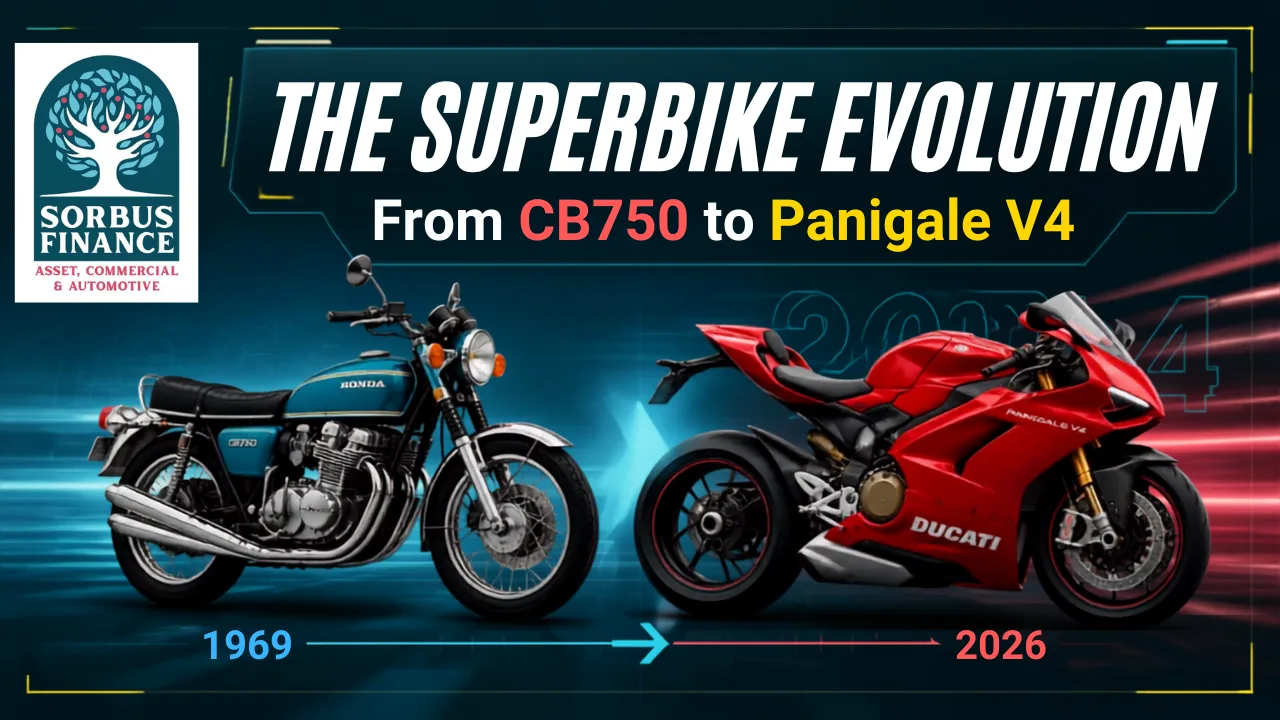
From the CB750 to the Panigale V4: The Evolution of the Superbike Class
Ask ten riders what makes a superbike a superbike and you'll get ten different answers. One person says horsepower. Another says weight. Someone else swears it's whatever bike currently holds the lap record down at their local track. They're all a bit right, honestly. That's kind of the point of the superbike class.
The superbike class has never sat still. It's been redefined roughly once a decade since 1969, and every time it happens, one superbike drags the rest of the industry along behind it. This isn't a spec-sheet history lesson. It's the story of a few machines that each, in their own way, forced everyone else in the superbike class to catch up.
Where the Word "Superbike" Actually Came From
Every conversation about the superbike class eventually lands on the same bike. The Honda CB750, launched in 1969, is widely credited as the machine that gave the class its name.
Before the CB750, a fast road bike usually meant a British twin with a drum brake and a habit of leaking oil on your driveway. Honda turned up with an air-cooled four-cylinder engine, a front disc brake, and an electric starter, all wrapped in a bike ordinary people could actually afford and ride every day. It was the first bike that genuinely earned the word "superbike," and the term stuck.
What made this superbike a big deal wasn't just what it could do. It was who could buy it. The CB750 went on sale in the US in the summer of 1969 for $1,495, undercutting a comparable British sports bike by a huge margin, despite being shipped halfway round the world. Performance that had belonged to race-only specials was suddenly parked in a Honda showroom.
Kawasaki hit back with the four-cylinder Z1 in 1973. Suzuki followed with its GS range not long after. That run of bikes kicked off a whole era nicknamed the UJM, short for Universal Japanese Motorcycle. Big multi-cylinder engine, disc brakes, a chassis that could just about keep up with the power. That was the template for the early superbike class, and for a while, it was enough.
The Race Replica Changes the Rules
If the CB750 invented the superbike class, the Suzuki GSX-R750 rewrote its rulebook. When it landed in 1985, the GSX-R wasn't trying to be a comfy road bike with sporty pretensions. It was built the other way round, starting from the racetrack and working backwards toward the road.
This was the first true "race replica" superbike. A no-compromise, track-focused machine you could ride straight out of the crate and take racing. No previous bike in the class had gone that far. Suzuki built it around its endurance racing programme, wrapping an oil-cooled four-cylinder engine in a proper aluminium alloy frame, with flatslide carburettors, twin front discs, and 18-inch wheels front and rear. Suzuki chose an oil-cooled engine specifically because it saved weight over the water-cooled units everyone else was using.
The numbers are still impressive today. Over 100PS, and a dry weight of just 179kg, roughly what a 400cc bike weighed at the time. That combination mattered more than anything else in the story of the superbike class. Suzuki had proven that raw horsepower was only half the job. Power-to-weight, and how well a chassis actually used that power, was the real currency. Every serious superbike since, from every manufacturer, is still chasing that same idea.
The World Superbike Championship Arrives
The GSX-R750 landed just as racing itself was changing shape. Grand Prix bikes were turning into exotic prototypes with little in common with anything you could buy. In 1988, the FIM launched the Superbike World Championship to fix that. The whole idea was to race production bikes, not one-off prototypes.
The formula was simple and brilliant. Take road-going superbikes people could actually buy from a dealer, modify them within a strict rulebook, and let them race. For years the rules pitted 1,000cc V-twins, mostly from Ducati, against 750cc four-cylinder bikes from Honda, Yamaha, Kawasaki, and Suzuki.
The very first race, at Donington Park in April 1988, threw up a shock result. Marco Lucchinelli's factory Ducati 851, the only twin on the grid that day, won outright against a field of four-cylinder bikes that had written the V-twin off as a makeweight. It was an early sign that the superbike class was never going to be as simple as "most cylinders wins."
For UK fans, this mattered a lot. WSBK became something you could genuinely connect with, because you could go and watch the exact superbike on track that your mate down the road was riding to work on Monday morning. That link between showroom and racetrack is still what sets World Superbikes apart from MotoGP today. You can read more on the history and current calendar over on the official WorldSBK site.
The Ducati 916: When a Superbike Became Art
No history of the superbike class is complete without talking about how these bikes look, because for a few years in the 1990s, one machine made that question feel almost as important as lap times.
The Ducati 916 arrived in 1994, designed by Massimo Tamburini and built around Massimo Bordi's four-valve desmodromic V-twin. It became an instant classic and pretty much defined superbike style for the rest of the decade. The single-sided swingarm and under-seat exhausts weren't just there to look good either. The swingarm made wheel changes faster during endurance racing, and Tamburini himself admitted the under-seat exhaust idea came from Honda's NR750.
It backed all that style up with results. The 916 took five WorldSBK titles between 1994 and 1999, four of them with Carl Fogarty aboard and one with Troy Corser, before a bigger 996cc version added another the year after. Every superbike built since has had to deal with the 916 somehow, either chasing its drama or deliberately running the opposite direction. Its influence over the superbike class went well beyond the racetrack, and you can still see its fingerprints on Ducati's design language today, right through to the current Panigale.
The Electronics Revolution
For most of its history, the superbike class was limited by mechanics. More power, less weight, better brakes, stickier tyres. Then, in the late 2000s, the real fight moved somewhere else entirely: into the software.
When the BMW S1000RR went into full production in 2009, it reset expectations again. It arrived with ABS and traction control fitted as standard, both firsts for the class. Claimed output was 193hp, with a dry weight of around 183kg, numbers that would have sounded like science fiction to a rider a generation earlier. But the horsepower wasn't really the story. The way that power got managed was.
BMW gave the S1000RR three riding modes as standard, Wet, Sport, and Race, with a fourth Slick mode available separately. Suddenly a rider could dial the bike's character to match the conditions, or their own confidence, on any given day.
That's the bit that actually changed things for road riders. A superbike with good traction control, cornering ABS, and a quickshifter isn't necessarily quicker in a straight line. But it's far more usable at nine-tenths, and much more forgiving when a patch of diesel or a cold tyre catches you out mid-corner. Today's flagship superbikes, from the Panigale V4 to Honda's Fireblade SP, build IMU-based electronics so deep into the chassis that the rider aids and the mechanical package barely feel separate any more. It's a world away from where the superbike class started. If you want to see how far that's come, Ducati's own Panigale pages are worth a browse.
So What Actually Defines the Superbike Class?
Follow the line from the CB750, through the GSX-R750, the 916, and the S1000RR, and you notice the definition keeps shifting because the argument keeps shifting. In 1969, it was about accessibility. In 1985, it was about weight and race pedigree. In 1994, it was about design as much as data. By 2009, it was about how smart a bike was with its own power.
What hasn't changed is the underlying idea behind the superbike class itself: it's always the bike that makes everything else on the showroom floor look a generation behind. That's a genuinely hard thing for any superbike to pull off, and an even harder thing to keep doing every few years. Which is exactly why the handful of bikes that managed it are still talked about decades later.
Owning a Piece of Superbike History
Whichever era speaks to you, whether that's a restored slabside GSX-R750, a 916 you've been eyeing up on the classifieds for years, or a brand-new litre bike loaded with the latest electronics, buying at this end of the market is a different conversation to picking up a runabout. If you're weighing up how best to structure that kind of purchase, it's worth reading through why more owners are choosing to finance superbikes rather than buying outright, and taking a look at how prestige asset finance works for bikes in this category.
Ready to act on what you've read?
Get a free, no-obligation quote from 100+ UK lenders
Ready to find the right finance for your business?
Our independent advisers compare 100+ UK lenders to find the deal that fits your business, no upfront fees, no obligation.